
Leer la versión en Español aquí

With the boom of artificial intelligence that we are experiencing (and suffering), in most companies there is a mandate to “start using AI.” Nobody really knows how or for what, but it must be used.

And so, there is a huge proliferation of “AI projects” within organizations, and trying to organize them is becoming unmanageable—ironically creating the same inefficiencies that AI was meant to solve.

This AI Strategic Map is designed to help organize current initiatives and create new ones with purpose and strategy.

This model combines three concepts/frameworks of innovation and strategy:

  • The idea of value creation/capture
  • The three horizons of growth
  • The three functions of AI—my own creation, but based on Dr. Puentedura’s SAMR model

Let’s first explore each concept separately, and then bring them together to see how they reinforce each other when combined.

Creating and Capturing Value

Strategy literature distinguishes two ways in which projects and initiatives can be classified: value creation and value capture.

Value capture refers to the ability to extract value from existing resources and processes. It’s about optimizing what already works: speeding up processes, generating operational efficiencies that reduce costs. The focus is on doing better what we already do.

Examples of AI-driven value capture projects: reducing design and development cycles, automating reports, or eliminating manual steps. These provide a clear and quick return on investment.

Value creation, on the other hand, involves generating completely new value for customers and markets. It’s not just about doing things more efficiently, but about doing fundamentally different things that were not possible before.

Examples of AI-driven value creation projects: analyzing massive datasets to detect unmet needs, generating real-time personalized experiences, creating hyper-personalized products (podcasts, videos, books tailored to each person based on their own parameters).

In most organizations, the natural first step is to “plug in AI” to optimize existing work processes:

  • These improvements are easier to identify.
  • They less risky, because optimizing an existing process is safer than launching a new product.
  • They are quick wins that provide visible, measurable short-term improvements.
  • They have a more direct and faster ROI.
  • Resistance to change is lower since these projects involve incremental adjustments rather than entirely new ways of working.

For Operations and Technology teams—who usually lead these projects—using AI for optimization is also a natural fit because it directly impacts the KPIs they are measured on: efficiency, costs, delivery times.

However… while most companies start with value capture, AI’s true potential lies in value creation. More on that in a moment.

The Three Functions of AI and Their Strategic Potential

Even though the possibilities opened by AI are vast and we’re just beginning to uncover its potential, we can distinguish three main functions:

  • Automate
  • Augment
  • Generate

Automate and Replace → Value Capture

This is the most obvious function and the first one to be used in most companies. This is where AI replaces repetitive human tasks: chatbots for customer service, automated financial reports, document processing.

The appeal is immediate: reduced labor costs, faster turnaround times, fewer human errors. However, these implementations rarely create sustainable competitive advantages, since they are easily replicable by competitors.

Augment → Hybrid Territory

Here AI enhances existing human capabilities, allowing for improvements in existing processes (value capture) while also enabling the creation of new opportunities (value creation).

For example: an engineer can process massive datasets that were previously unmanageable, uncovering insights that allow the creation of new materials. A designer can generate hundreds of concept variations in minutes. A programmer can write code faster with AI assistants.

Generate → Value Creation

AI’s generative capacity opens up possibilities that didn’t exist before: mass product personalization, unique content creation for each user (from personalized help to entire books, podcasts, or videos), designing molecules for new drugs.

These applications create entirely new markets, products, and experiences.

These three AI functions are inspired by Dr. Rubén Puentedura’s SAMR model (Substitution, Augmentation, Modification, Redefinition), originally designed to help incorporate technology in education.

The Three Horizons of Growth

The Three Horizons of Growth framework was developed by consulting firm McKinsey to help companies think about growth and the future in a structured way. Provides a structure for companies to assess potential opportunities for growth without neglecting performance in the present.

Horizon 1: The short-term horizon, focused on improving existing processes and products to generate and sustain competitive advantages. Since the focus is short-term, these projects are expected to deliver results in 1–3 years.

Horizon 2: Projects aimed at growth through new products for existing customers, or moving into adjacent markets with current products. Since developing new products often requires more complex technology, these projects traditionally took longer to pay off. However, AI and technological advances are shortening these timelines.

Horizon 3: Initiatives that create entirely new categories or business models, generating competitive advantages that are hard to copy—at least in the short term. The impact of these projects is usually seen in 3–5+ years, and here AI plays a fundamental role.

AI Innovation Map

Now that we’ve explored each concept separately, let’s see how the AI Innovation Map brings these three ideas together, helping organizations structure their AI initiatives with a strategic vision.

This model is useful for mapping existing initiatives and planning future ones based on:

  • The type of value they provide (creation, capture)
  • The expected results and timeframe (short, medium, long term)
  • The AI function they leverage (automation, augmentation, generation)
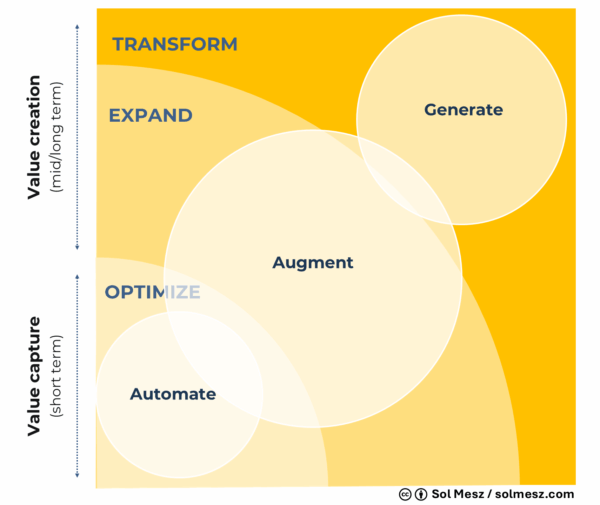
AI Strategy Map

Some examples

Horizon 1

Value Capture, Automate: automatic generation of product documentation, creation of a recommendation or customer service chatbot.

Horizon 2

Value Creation, Augment: large-scale behavioral analysis to identify behavior segments.

Value Creation, Augment + Generate: dynamic bundles and new product combinations.

Horizon 3

Value Creation, Generate: products that personalize the experience in real time, agents that create applications on demand.

Download a PDF with the AI strategy map (ready to use in virtual boards such as FigJam, Mural, etc.) can be downloaded here.

De éste y otros temas hablamos en nuestros cursos

Nothing Found

Leer la versión en Español aquí

With the boom of artificial intelligence that we are experiencing (and suffering), in most companies there is a mandate to “start using AI.” Nobody really knows how or for what, but it must be used.

And so, there is a huge proliferation of “AI projects” within organizations, and trying to organize them is becoming unmanageable—ironically creating the same inefficiencies that AI was meant to solve.

This AI Strategic Map is designed to help organize current initiatives and create new ones with purpose and strategy.

This model combines three concepts/frameworks of innovation and strategy:

  • The idea of value creation/capture
  • The three horizons of growth
  • The three functions of AI—my own creation, but based on Dr. Puentedura’s SAMR model

Let’s first explore each concept separately, and then bring them together to see how they reinforce each other when combined.

Creating and Capturing Value

Strategy literature distinguishes two ways in which projects and initiatives can be classified: value creation and value capture.

Value capture refers to the ability to extract value from existing resources and processes. It’s about optimizing what already works: speeding up processes, generating operational efficiencies that reduce costs. The focus is on doing better what we already do.

Examples of AI-driven value capture projects: reducing design and development cycles, automating reports, or eliminating manual steps. These provide a clear and quick return on investment.

Value creation, on the other hand, involves generating completely new value for customers and markets. It’s not just about doing things more efficiently, but about doing fundamentally different things that were not possible before.

Examples of AI-driven value creation projects: analyzing massive datasets to detect unmet needs, generating real-time personalized experiences, creating hyper-personalized products (podcasts, videos, books tailored to each person based on their own parameters).

In most organizations, the natural first step is to “plug in AI” to optimize existing work processes:

  • These improvements are easier to identify.
  • They less risky, because optimizing an existing process is safer than launching a new product.
  • They are quick wins that provide visible, measurable short-term improvements.
  • They have a more direct and faster ROI.
  • Resistance to change is lower since these projects involve incremental adjustments rather than entirely new ways of working.

For Operations and Technology teams—who usually lead these projects—using AI for optimization is also a natural fit because it directly impacts the KPIs they are measured on: efficiency, costs, delivery times.

However… while most companies start with value capture, AI’s true potential lies in value creation. More on that in a moment.

The Three Functions of AI and Their Strategic Potential

Even though the possibilities opened by AI are vast and we’re just beginning to uncover its potential, we can distinguish three main functions:

  • Automate
  • Augment
  • Generate

Automate and Replace → Value Capture

This is the most obvious function and the first one to be used in most companies. This is where AI replaces repetitive human tasks: chatbots for customer service, automated financial reports, document processing.

The appeal is immediate: reduced labor costs, faster turnaround times, fewer human errors. However, these implementations rarely create sustainable competitive advantages, since they are easily replicable by competitors.

Augment → Hybrid Territory

Here AI enhances existing human capabilities, allowing for improvements in existing processes (value capture) while also enabling the creation of new opportunities (value creation).

For example: an engineer can process massive datasets that were previously unmanageable, uncovering insights that allow the creation of new materials. A designer can generate hundreds of concept variations in minutes. A programmer can write code faster with AI assistants.

Generate → Value Creation

AI’s generative capacity opens up possibilities that didn’t exist before: mass product personalization, unique content creation for each user (from personalized help to entire books, podcasts, or videos), designing molecules for new drugs.

These applications create entirely new markets, products, and experiences.

These three AI functions are inspired by Dr. Rubén Puentedura’s SAMR model (Substitution, Augmentation, Modification, Redefinition), originally designed to help incorporate technology in education.

The Three Horizons of Growth

The Three Horizons of Growth framework was developed by consulting firm McKinsey to help companies think about growth and the future in a structured way. Provides a structure for companies to assess potential opportunities for growth without neglecting performance in the present.

Horizon 1: The short-term horizon, focused on improving existing processes and products to generate and sustain competitive advantages. Since the focus is short-term, these projects are expected to deliver results in 1–3 years.

Horizon 2: Projects aimed at growth through new products for existing customers, or moving into adjacent markets with current products. Since developing new products often requires more complex technology, these projects traditionally took longer to pay off. However, AI and technological advances are shortening these timelines.

Horizon 3: Initiatives that create entirely new categories or business models, generating competitive advantages that are hard to copy—at least in the short term. The impact of these projects is usually seen in 3–5+ years, and here AI plays a fundamental role.

AI Innovation Map

Now that we’ve explored each concept separately, let’s see how the AI Innovation Map brings these three ideas together, helping organizations structure their AI initiatives with a strategic vision.

This model is useful for mapping existing initiatives and planning future ones based on:

  • The type of value they provide (creation, capture)
  • The expected results and timeframe (short, medium, long term)
  • The AI function they leverage (automation, augmentation, generation)
AI Strategy Map

Some examples

Horizon 1

Value Capture, Automate: automatic generation of product documentation, creation of a recommendation or customer service chatbot.

Horizon 2

Value Creation, Augment: large-scale behavioral analysis to identify behavior segments.

Value Creation, Augment + Generate: dynamic bundles and new product combinations.

Horizon 3

Value Creation, Generate: products that personalize the experience in real time, agents that create applications on demand.

Download a PDF with the AI strategy map (ready to use in virtual boards such as FigJam, Mural, etc.) can be downloaded here.

De éste y otros temas hablamos en nuestros cursos

Nothing Found

Related content